
Can 3D Printed Mold Inserts Replace Metal Tooling for Short Injection Molding Runs?
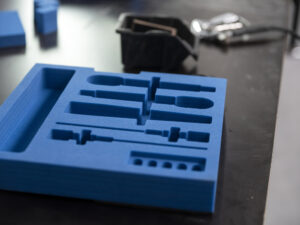
Yes, for the right project. 3D printed mold inserts can replace machined metal tooling for short injection molding runs, prototype testing, and bridge production while permanent steel tools are being built. They will not match the lifespan of hardened steel, but they can be produced in hours instead of weeks and at a fraction of the cost. At ProTek Models, we print high-temperature mold inserts on NEXA3D resin printers that deliver the heat resistance and surface finish this application demands.
What Are 3D Printed Mold Inserts?
A mold insert is the cavity and core portion of an injection mold that shapes the plastic part. Instead of machining these inserts from aluminum or steel, they are 3D printed in a heat-resistant resin and mounted into a standard mold base. The press, the base, and the molding process stay the same. Only the insert changes, which makes it fast and inexpensive to test new designs.
Which Materials Work for Printed Injection Mold Tooling?
Not every 3D printing resin can survive molten plastic under pressure. Mold inserts require materials with high heat deflection temperatures and good dimensional stability. ProTek Models offers two resins well suited for this work:
- xPEEK147 : A high-temperature resin with a heat deflection temperature of 230°C, designed specifically for tooling and molding applications.
- xCE-Black and xCE-White : High-performance polymers formulated for producing end-use plastic parts and injection molding tools quickly.
Both are printed with NEXA3D’s ultrafast LSPc technology, which produces the fine detail and smooth surface finish that transfers directly to molded parts. Learn more about the process on our DLP/SLA 3D printing services page.
When Do Printed Mold Inserts Make the Most Sense?
Printed inserts are a strong fit when speed and flexibility matter more than tool life. Common use cases include:
- Design validation : Mold real parts in the final production material to test fit, function, and assembly.
- Bridge tooling : Produce parts to keep a product launch on schedule while steel tooling is still being machined.
- Short production runs : Make small batches of parts where a metal tool would never pay for itself.
- Material testing : Compare how different thermoplastics perform before committing to a final resin.
- Rapid iteration : Update the CAD file and print a revised insert the same day.
What Are the Limitations of 3D Printed Mold Inserts?
Printed inserts work best within realistic expectations. Insert life depends on the plastic being molded, the part geometry, and the cycle settings, and it is far shorter than a steel tool. Highly abrasive glass-filled materials and very high melt temperatures shorten insert life further. Longer cooling times are usually needed because resin does not pull heat away as quickly as metal. Our team will review your part and molding requirements to confirm whether printed inserts are the right fit.
How Do Printed Inserts Compare to Urethane Casting?
Both processes support low-volume production, but they serve different goals. Printed mold inserts produce parts in true injection molding thermoplastics, which is critical when you need to validate the exact production material. Urethane casting uses silicone molds and polyurethane materials, making it ideal for larger parts, a wide range of hardness levels, and runs where injection molding resin is not required. ProTek Models offers both, so we can recommend the most practical path for your project.
Get Your Injection Mold Inserts From ProTek Models
If you need molded parts fast without the cost and lead time of metal tooling, 3D printed mold inserts may be the answer. The experienced team at ProTek Models will help you select the right material, prepare your design, and deliver inserts ready for your press. Call (832) 968-6636 today or request a 3D printing quote to start your project.